Coin Grading Guide: How Coin Grading Works
A complete guide to coin grading — what it is, what graders evaluate, the major services (PCGS, NGC, ANACS, ICG), and whether it's worth it. Links to deep dives on the Sheldon scale, grading costs, and how to submit coins.
What Is Coin Grading?
Coin grading is the process of evaluating a coin's physical condition and assigning it a numeric grade that represents its level of preservation. The grade directly affects a coin's market value — the difference between a VF-30 and an MS-65 example of the same coin can be thousands or even tens of thousands of dollars.
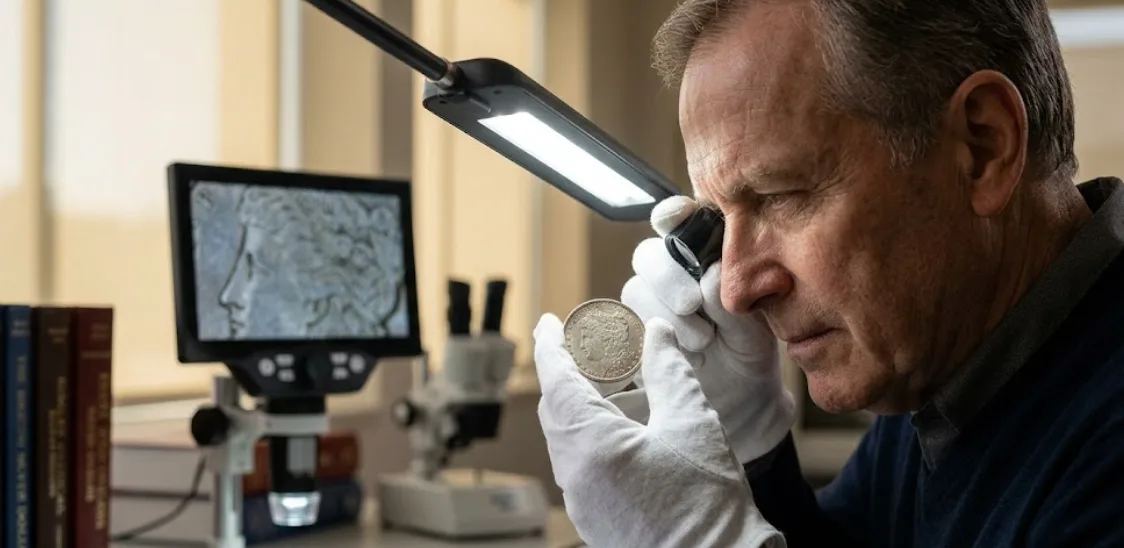
Professional grading services examine coins under magnification, assess factors like wear, luster, strike quality, and eye appeal, then seal the coin in a tamper-evident holder (called a "slab") with a label showing the assigned grade. This provides buyers and sellers with a trusted, standardized assessment.
The Sheldon Grading Scale (1–70)
All major grading services use the Sheldon scale, a numeric system from 1 to 70 developed by Dr. William Sheldon in 1949. The scale is divided into categories based on the amount of wear visible on the coin (see our full Sheldon scale guide for every grade explained):
| Grade Range | Category | Description |
|---|---|---|
| P-1 | Poor | Barely identifiable, heavy wear |
| FR-2 | Fair | Heavily worn, outline visible |
| AG-3 | About Good | Very heavily worn, major details clear |
| G-4 to G-6 | Good | Major design elements visible, most details worn smooth |
| VG-8 to VG-10 | Very Good | Design clear, some details visible |
| F-12 to F-15 | Fine | Moderate wear on high points, all lettering sharp |
| VF-20 to VF-35 | Very Fine | Light to moderate wear, major features sharp |
| EF-40 to EF-45 | Extremely Fine | Light wear on highest points only |
| AU-50 to AU-58 | About Uncirculated | Slight wear on the highest points, most luster remaining |
| MS-60 to MS-70 | Mint State | No wear — uncirculated. MS-70 is a theoretically perfect coin |
| PF-60 to PF-70 | Proof | Specially struck coins with mirror-like fields |
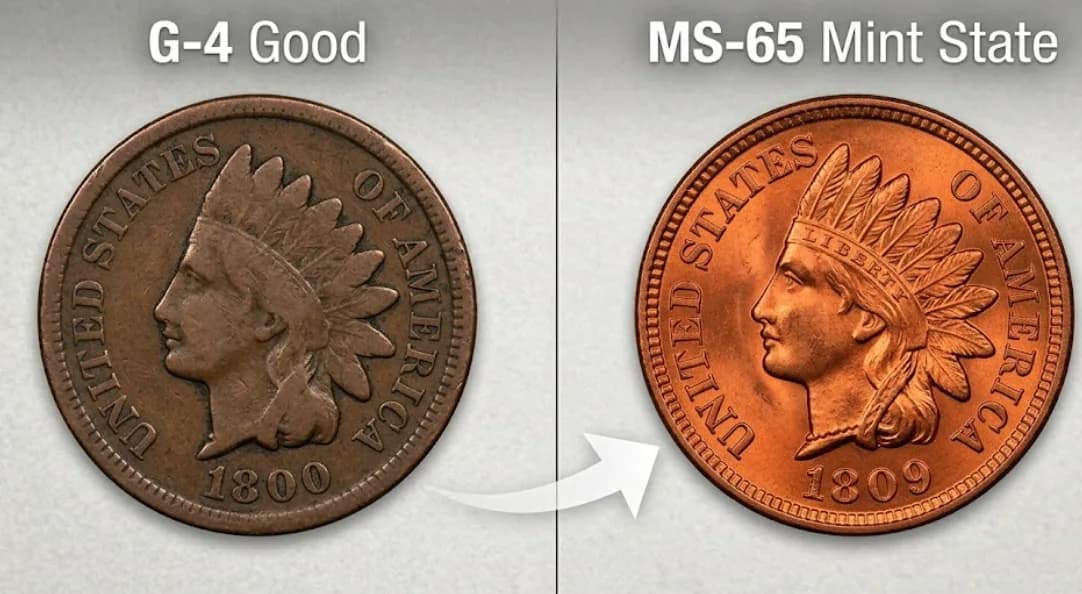
As the comparison image above illustrates, the visual difference between G-4 and MS-65 is staggering, and so is the price differential.
What Graders Actually Evaluate
A coin's grade isn't a single measurement — it's a judgment that balances several distinct factors. Two coins can share the same numeric grade for very different reasons, which is why experienced graders look at each of these elements:
- Strike — How completely and sharply the design transferred from the dies to the planchet. A weak strike leaves high points (hair, feathers, stars) soft even on an unworn coin.
- Luster— The reflective "cartwheel" sheen created by metal flow lines during striking. Original, undisturbed luster is a hallmark of Mint State coins; cleaning or wear breaks it up.
- Surface preservation— The number, size, and location of contact marks, hairlines, and abrasions. Marks in prime focal areas (a portrait's cheek) hurt the grade far more than marks hidden in the design.
- Eye appeal— The coin's overall attractiveness, including color and toning. Strong eye appeal can lift a grade; unattractive or questionable toning can lower it.
- Authenticity — Before any grade is assigned, the coin must be verified as genuine and free of alterations. This is the foundation the entire grade rests on.
Understanding Mint State: MS-60 Through MS-70
Most modern collecting and investing happens in the Mint State range, where coins show no wear at all but still vary enormously in quality and price. The difference between MS-63 and MS-66 on a scarce coin can be the difference between a few hundred and several thousand dollars. Here is what separates each level:
| Grade | Common Name | What It Looks Like |
|---|---|---|
| MS-60 | Uncirculated | No wear, but heavy bag marks and weak or broken luster |
| MS-61–62 | Uncirculated | No wear; numerous marks and below-average eye appeal |
| MS-63 | Choice BU | Moderate marks, decent luster, average eye appeal |
| MS-64 | Choice BU | Above-average surfaces with only minor distractions |
| MS-65 | Gem BU | Strong luster, very few marks, excellent eye appeal |
| MS-66–67 | Superb Gem | Exceptional surfaces with only the faintest marks |
| MS-68–69 | Superb Gem | Nearly flawless; imperfections need magnification to find |
| MS-70 | Perfect | No imperfections visible at 5x magnification |
Proof coins use the same numbers with a PF or PR prefix (for example, PF-69). Proofs are specially struck collector coins with mirror-like fields, not business strikes pulled from circulation.
Special Designations and Strike Qualifiers
Beyond the numeric grade, slabs often carry abbreviations that flag an exceptional strike or surface. These designations can add a significant premium because they mark the finest examples of a given coin. The exact abbreviations vary slightly between services, but the most common ones are:
| Designation | Meaning | Typically Seen On |
|---|---|---|
| + (Plus) | High end of the assigned grade | Any series |
| ★ (Star) | Exceptional eye appeal for the grade | Any series (NGC) |
| CAM / DCAM | Cameo / Deep Cameo — frosted devices over mirrored fields | Proof coins |
| PL / DMPL | Prooflike / Deep Mirror Prooflike reflective surfaces | Morgan dollars |
| FB | Full Bands — fully struck horizontal bands | Mercury dimes |
| FS | Full Steps — complete Monticello steps | Jefferson nickels |
| FBL | Full Bell Lines on the Liberty Bell | Franklin half dollars |
| FH | Full Head on the Liberty portrait | Standing Liberty quarters |
How Professional Grading Works
The grading process follows a standard workflow at all major services (for a hands-on walkthrough, see how to get a coin graded and what coin grading costs):
- Submission — You send your coins to the grading service (directly, through a dealer, or at a coin show). Each coin is logged and assigned a submission number.
- Authentication — Experts verify the coin is genuine, checking for counterfeits, alterations, and artificial toning.
- Grading — Multiple graders independently evaluate the coin and assign a grade. Their assessments are combined into a final grade using the 1-70 scale.
- Encapsulation — The coin is sealed in a sonically welded, tamper-evident plastic holder with a label showing the grade, date, denomination, and certification number.
- Return — The slabbed coin is shipped back to you, ready for your collection or sale.
Major Coin Grading Companies
Five companies dominate the professional coin grading market. Each has different strengths, pricing, and areas of specialization:
PCGS
Professional Coin Grading Service
The most widely recognized grading service for US coins. Founded in 1986, PCGS has graded over 200 million coins.
NGC
Numismatic Guaranty Company
The world's largest third-party grading service. Preferred for world coins, ancient coins, and tokens.
ANACS
ANACS (formerly American Numismatic Association Certification Service)
The oldest grading service in the US, founded in 1972. Known for affordable grading and variety attributions.
ICG
Independent Coin Graders
An independent grading service offering competitive pricing and fast turnaround times.
CGC
Certified Guaranty Company
A newer entrant to coin grading from the trusted CGC brand, known for comics and trading cards grading.
Not sure which service to choose? See our grading service comparison for a side-by-side breakdown of pricing, turnaround, specialties, and who each service is best for.
Submitting Coins at Coin Shows
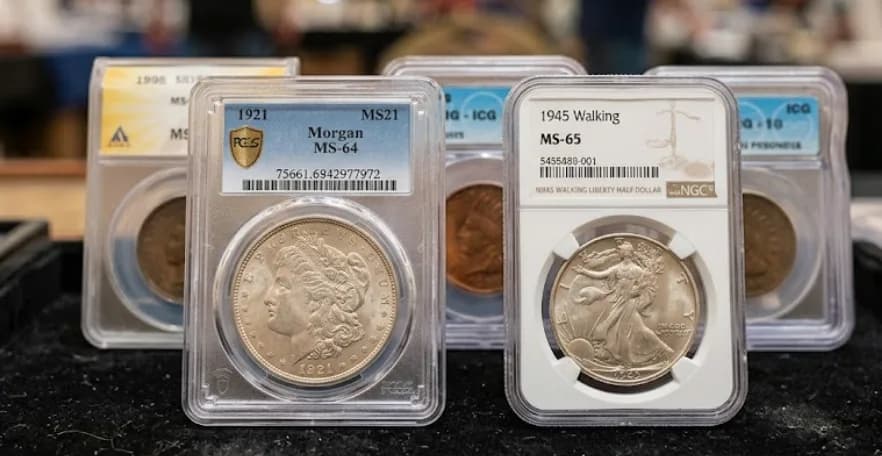
The labels and tamper-evident holders shown above are standard — each includes the specific grade and authentication details described in our company overview.
One of the best places to submit coins for grading is at a coin show. Major shows often have on-site representatives from PCGS, NGC, and ANACS accepting submissions directly. This eliminates shipping risk and sometimes offers faster turnaround. Check our state-by-state show listings to find events near you where grading submissions are available.
Why Some Coins Don't Get a Grade
Not every coin that goes into a grading service comes back with a clean numeric grade. When a coin is genuine but has a problem, the service returns it with a "Details" grade instead — for example, "AU Details — Cleaned". The coin is still encapsulated and authenticated, but the label notes the issue, and the coin trades at a steep discount to a problem-free example. The most common reasons a coin receives a Details grade are:
- Cleaning — Hairlines or unnatural brightness from being wiped, polished, or dipped.
- Damage — Scratches, rim dings, holes, bends, or graffiti.
- Environmental damage — Corrosion, verdigris, or spots from improper storage.
- Altered surfaces — Artificial toning, tooling, whizzing, or added/removed mint marks.
- PVC residue — Green film left by storing coins in soft vinyl flips.
The single most important rule in the hobby: never clean your coins.What looks like "improvement" almost always strips original surfaces and converts a straight-gradeable coin into a Details coin, permanently lowering its value. If a coin is dirty, leave it as-is and let the experts evaluate it.
CAC Verification: The "Green Bean"
You may notice a small green or gold sticker on some slabs. These come from CAC (Certified Acceptance Corporation), founded by veteran numismatist John Albanese in 2007. CAC reviews coins that are already graded by PCGS or NGC and verifies whether they are solid for the assigned grade:
- Green sticker — The coin is solid-to-premium quality for its grade (an "A" or "B" coin).
- Gold sticker — The coin is undergraded and would likely earn a higher grade on resubmission.
Because CAC-verified coins screen out the low end of each grade, they frequently command a premium over non-stickered examples. In 2023 CAC also launched its own grading service, CACG, which grades coins directly rather than only stickering existing slabs.
How to Prepare and Submit Your Coins
Whether you submit by mail or hand coins to a representative at a show, a little preparation protects both your coins and your grading fees:
- Don't clean anything. As above, this is the fastest way to ruin a coin's value.
- Handle coins by the edges, ideally with cotton or nitrile gloves, and never talk directly over an exposed coin.
- Get coins out of PVC flips and into inert holders (cardboard 2x2s or Mylar flips) before submission.
- Pick the right service tier. Every service caps the coin value each tier covers, so match the tier to your coin's worth.
- Declare an accurate value. This sets the grading fee and the insurance coverage if anything happens in transit.
- Pack securely and insure the shipment — or skip shipping entirely by submitting in person at a coin show.
Is Coin Grading Worth It?
Grading isn't free, so the question is whether the slab adds more value than it costs. As a rule of thumb, grading makes sense when a coin is worth roughly $100 or more in its likely grade, or in these situations:
- Key dates, rare varieties, and high-grade Mint State coins where a single grade point moves the price sharply.
- Coins you intend to sell sight-unseen online, where buyers pay more for a certified grade.
- Expensive or frequently-counterfeited coins that need authentication for buyer confidence or insurance.
- Inherited or estate coins of unknown value that you want objectively assessed.
Grading is usually not worth it for common circulated coins or low-value modern issues, where the fee and shipping would exceed any premium. When in doubt, ask a dealer at a show for a quick opinion before you commit to a submission. For a side-by-side look at what each service charges, see our grading service comparison.